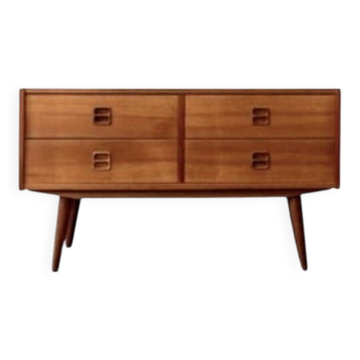
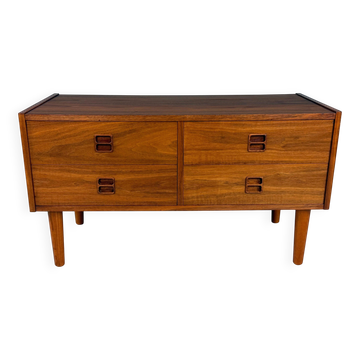
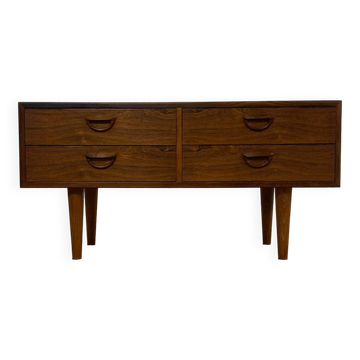
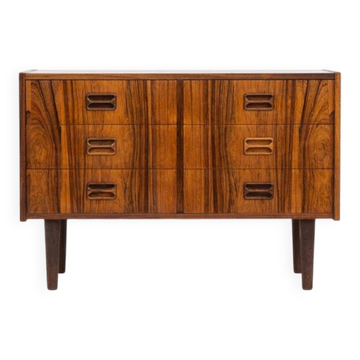
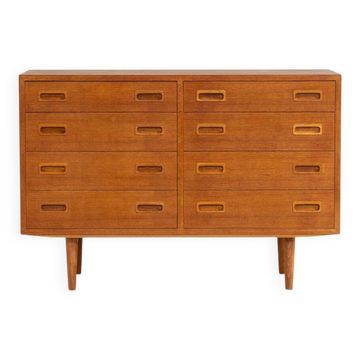
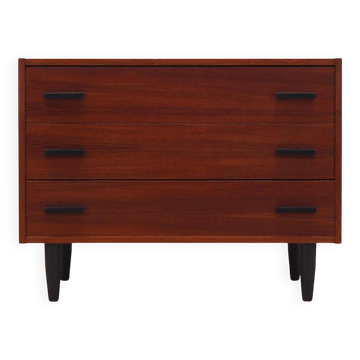
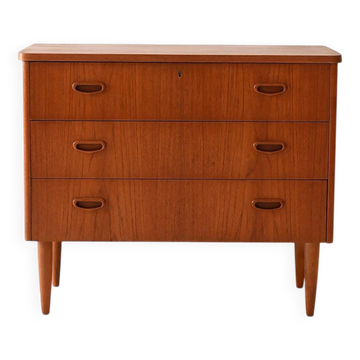
Danish teak chest of drawers with recessed handles, four drawers, 1960s

- Dimensions :
- H52 x W88.5 x D49.5
- Color :
- brown
- Material :
- wood
- Style :
- scandinavian
A Danish chest of drawers from the 1960s, representing the mature phase of Scandinavian design when functionality and aesthetics achieved perfect balance. This compact piece combines the warmth of teak veneer with thoughtful construction, offering an elegant storage solution in a modest form. The structure rests on a rectangular body set upon four tapered solid wood legs that lend visual lightness and lift the piece from the floor. Four drawers arranged symmetrically fill the frame, each fitted with distinctive recessed pulls carved directly into the drawer fronts — wooden indentations that maintain the smooth veneer surface uninterrupted. This detail exemplifies Danish design philosophy of the era, where every element served both function and form. The proportions are carefully considered: width nearly twice the height creates a stable silhouette without heaviness. The 1960s marked a period when Danish furniture gained international recognition through its masterful combination of craft tradition with modern approach to form. Danish manufacturers perfected the technique of veneering furniture boards, achieving the elegant appearance of solid teak while maintaining affordability and structural stability. Teak, imported primarily from Southeast Asia, became the defining material of Scandinavian modernism — its warm tone and expressive grain pattern addressed the Nordic need for cosiness in interior spaces. The four drawers accommodate linens, documents, or everyday items. This chest of drawers works well in a bedroom as wardrobe supplement, in an entryway for accessories, or in a living room as discreet storage. The modest depth allows placement even in narrower spaces, while the top surface serves as a base for a lamp or decorative objects. The piece is in good condition with natural signs of decades of use: minor scratches on the veneer surface and small chips. Small losses have been professionally filled during restoration. The more noticeable traces of use are also documented in the photographs, so that the actual state of preservation is conveyed as faithfully as possible.
4.93 ()
Chests of drawers: other similar vintage pieces
Discover more similar items- Sold out
- -11%
- -25%
- Sold out
- -13%
- -15%
- Sold out
- -15%
- -10%