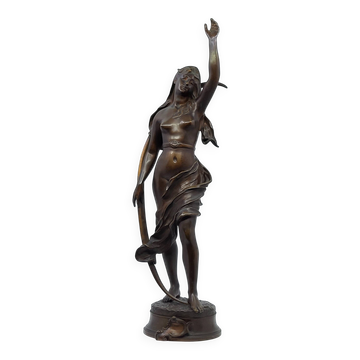
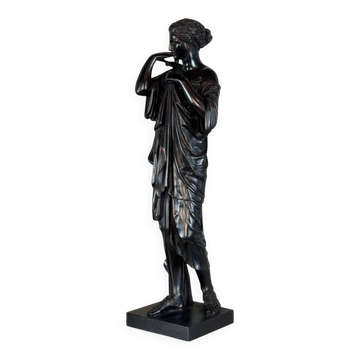
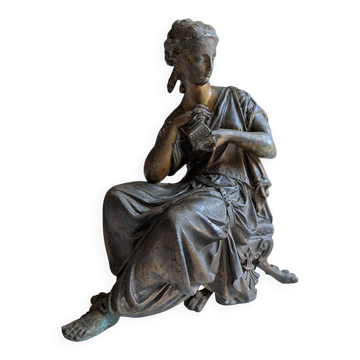
Antonin Mercié after Jean Léon Gérôme - Silvered bronze sculpture

- Dimensions :
- H41 x W10 x D10
- Color :
- silver (Color)
- Material :
- bronze
- Style :
- classic
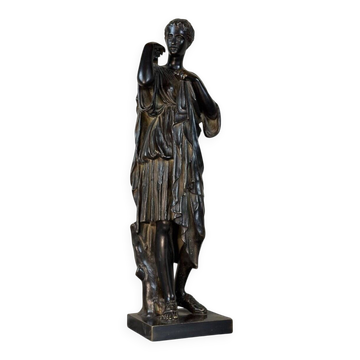
Antonin Mercié (1845-1916) after Jean Léon Gérôme (1824-1904) Sculpture in silvered bronze. The Almée or the Belly Dance. Casting by Goupil et cie from the 19th century, around 1875. She performs her dance by making her castanets (small finger cymbals) resonate. Her long skirt is adorned with fine engraved floral motifs. Signed on the terrace. This original model published by Goupil is very rare on the market, having been cast in only a limited number of copies. Height: 41.2 cm. Very good condition, wear to the patina. Bibliography: Gerald M. Ackerman, "Jean Leon Gérôme", ACR editions, Tours, 2000, reproduced p.380. "Gérôme et Goupil Art & Entreprise", editions of the Réunion des musées nationaux, 2000, bronze model reproduced on page 130 under number 1987 and pages 50-51. 1. A dazzling start and the Prix de Rome. He entered the École des Beaux-Arts in Paris where he studied under François Jouffroy and Alexandre Falguière. In 1868, at just 23 years old, he won the prestigious Premier Grand Prix de Rome with Theseus defeating the Minotaur, allowing him to become a resident at the mythical Villa Medici in Italy. 2. The singer of French patriotism. It is from Rome that Mercié sends to France the two absolute masterpieces that will secure his international fame: David defeating Goliath (1872): This bronze, showing the young biblical hero sheathing his sword with his foot on the giant head of Goliath, achieves wild triumph. France, wounded by the defeat of 1870, sees it as an allegory of hope and national courage against Prussia. Gloria Victis (Glory to the Vanquished, 1874): This immense allegorical monument shows a winged genius lifting a dying young French soldier. Having become the most famous patriotic work of the time, it was published in hundreds of bronze copies by the famous founder Ferdinand Barbedienne.