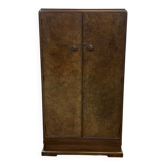
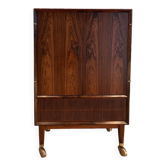
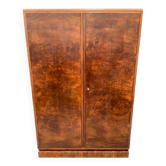
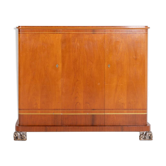
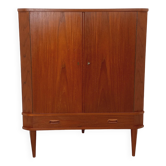
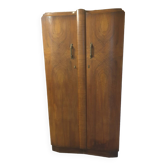
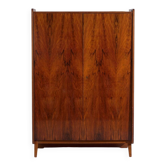
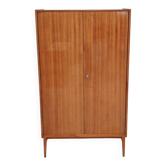
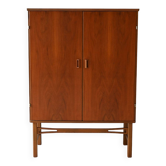
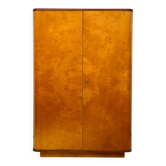
Jules Leleu cabinet in flame mahogany and nickel-plated metal 1930
This item has found its owner, but other one-of-a-kind items await you. 👇
Discover similar items- Dimensions :
- H160 x W86 x D41
- Color :
- multicolour
- Material :
- wood
- Style :
- art deco
Very beautiful Art Deco cabinet made of flame mahogany veneer in the 1930s by Jules Leleu, bearing the workshop stamp. This piece perfectly illustrates the refined aesthetic created by Leleu, where architectural rigor is combined with a sober and controlled elegance of the material, characteristic of the sophisticated language developed by the decorator, seeking a constant balance between monumentality and elegance. This cabinet does not deviate from this rule, standing out for the harmony of its proportions and the richness of its finishes. The body is characterised by straight and controlled lines, rhythmically complemented by a gentle curve on its upper part, enhancing the finesse and timelessness of this piece. This curved line interacts with the structural base elevating the central volume, giving the wardrobe a strong presence. The whole rests on a nickel-plated metal base, a typical detail of Leleu's approach, combining noble materials and modern elements. This subtle contrast between wood and metal reinforces the architectural character of the piece and attests to the craftsmanship of the Leleu workshops, where functionality is embedded in a very sober and remarkably timeless Art Deco aesthetic. Fully restored and varnished, this piece of furniture is in superb vintage condition. Jules Leleu (1883–1961) was a French decorator and furniture designer, a major figure in Art Deco and French design between the wars. Trained in applied arts and then at the Beaux-Arts, he developed a deep knowledge of materials and artisanal techniques early on, which he applied to high-quality furniture. After World War I, he established himself on the Parisian scene by offering luxurious ensembles, blending decorative elegance, precious woods, and exceptional craftsmanship. In the 1920s, his work is characterised by a refined and traditionalist Art Deco style, still imbued with classical references where richness...