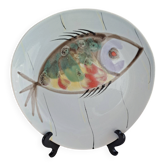
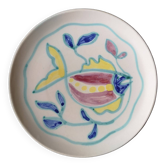
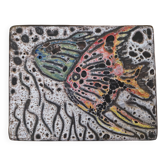
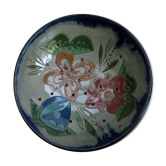
Hand-painted ceramic plate Tilgmans Sweden 1960

- Dimensions :
- H22 x W26 x D5
- Color :
- white
- Material :
- ceramics, porcelain and earthenware
- Style :
- vintage
Magnificent object handmade by the Swede Tilgmans Keramik. Fully glazed wall decoration depicting 2 fish and seaweed. Made around 1960 by the German-Swedish Paul Harald Tilgman in his workshop in a small town near Gothenburg, Sweden. Good condition. About Tilgmans Keramik: Paul Harris "Harry" Tilgmann was born in Dresden, Germany, in 1904. He emigrated to Sweden during World War II and established Tilgmans Keramik (= Ceramics) in 1948 in the small town of Utbynäs, near Gothenburg. Tilgmann employed 16 people, and when he hired Polish refugee Marian Zawadzki (1912-1978) as artistic director in 1953, Tilgmans Keramik began experimenting with the distinctive sgraffito technique. The sgraffito technique involves engraving fine lines into the background of a pattern through a light-coloured glaze down to a dark grey clay slip. This created a unique textured ground that became a style particularly associated with Tilgmans Keramik. The decorative elements also appear to be highlighted with a sculpted line, then hand-painted with overglazes where birds, fish, flowers, butterflies, and other animals were common themes. This type of work was most popular in Sweden in the mid-last century, alongside Tilgmans' small animal figurines. In 1957, production was moved to a new factory located in the same area, now employing 25 people. By the mid-1960s, nearly 80 people were working for Tilgman, and production evolved towards a darker, more rustic style. In 1971, Tilgman moved production to Londonderry, Ireland, while maintaining close collaboration with the employees who still worked for him in Gothenburg. Harry Tilgmann passed away in Helsinki, Finland, in 1974, and shortly after, the factory closed. Tilgmans Keramik remains one of the most popular and sought-after pieces of artistic ceramics in Scandinavia.
Dishes: other similar vintage pieces
Discover more similar items- Sold out
- -46%
- -25%
- -17%
- -14%
- Sold out
- -10%