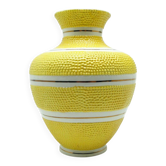
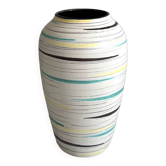
Vase, mid-century modern postmodernism, ceramics, Poland, 1970s

- Dimensions :
- H26 x W17 x D17
- Color :
- yellow
- Material :
- walnut
- Style :
- mid-century
A ceramic vase from the 1970s, made in the Katowice region, is an example of craftsmanship at the boundary between mid-century modern and postmodernism. The body features a wide, bulbous form that gently narrows towards the base and flares out at the neck and rim. The surface is a saturated, yellow colour—distinct and warm, providing a dominant visual accent. The character of the vessel is emphasised by horizontal, shiny stripes in white and metallic silver, spirally wrapping around the vase and clearly accentuating the division of the form. The entire piece is finished with a high-gloss glaze, and the outer layer is decorated with a regular, raised pattern of small dots, creating a tactile texture and three-dimensional light and shadow effects. The proportions remain clear and geometric, and the combination of a classic shape with unconventional colouring and finish reflects the spirit of experimentation of the decade. The condition is very good—no visible chips, cracks, or signs of wear; all elements appear original and have not been restored. The form of this vase, combining a gentle outline with bold colour and geometric rhythm of protrusions, speaks clearly of the 1970s, when Silesian studios and manufactories sought new languages of expression. This vessel could tell stories of colourful optimism and openness to modernity, where experimentation with glaze and colour was a manifesto of breaking away from everyday aesthetics. The yellow—bold, contrasted with the metallic coolness of silver—echoes modernist searches for light, while the texture of raised dots suggests a pursuit of tactile sensuality and the play of light on ceramics. The vase is like a joyful manifesto—a piece that suggests creative freedom and boldness of form, typical of the turn of the decade. It can be paired with minimalist teak or walnut furniture, where the intense yellow becomes the main accent. It works well in mid-century modern or eclectic collector's interiors, alongside a graphite lamp and Murano glass. It is worth combining it with a simple, low console or geometric table to emphasise the rhythm of the stripes and the surface structure. Suitable neighbours are also white, lacquered surfaces or steel details—then the metallic shine of the band will nicely reflect light in both natural and artificial arrangements.