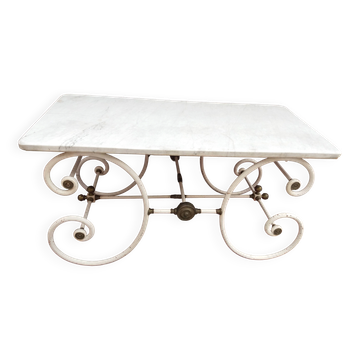
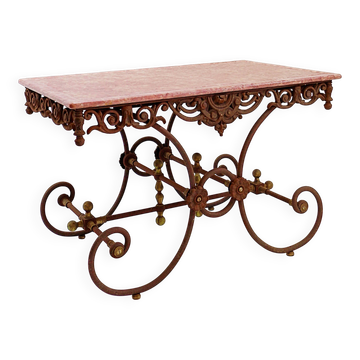
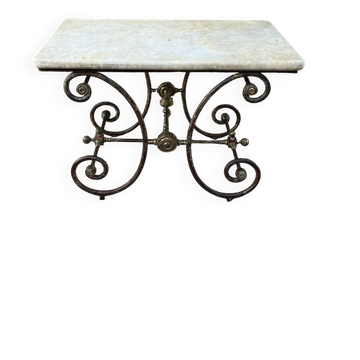
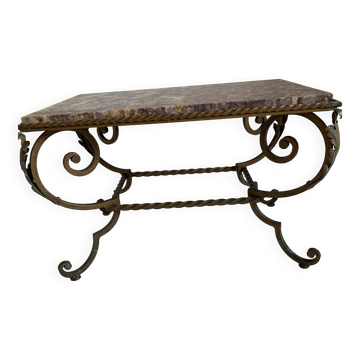
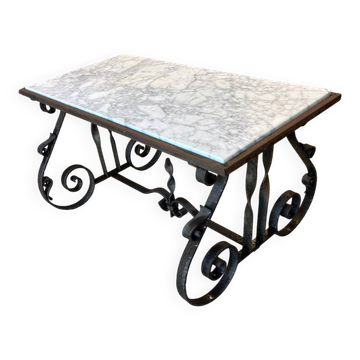
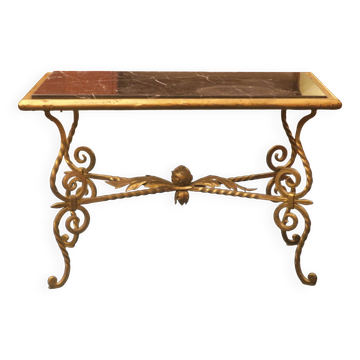
Table "Pastry", marble, Napoleon III, around 1890 – France

Wonderful pastry table or "pastry table" with a hand-forged iron structure and a large Carrara marble top. Carrara marble is one of the most used marbles throughout the history of art. It features a distinctive white color with multiple gray veins, characterized by its durability and elegance. It has been used for very significant works, such as the Pantheon of Agrippa or Michelangelo's "Pietà" and "David." The most special part of the piece is the lower section, as its structure is made of wrought iron. It consists of a skirt with scrolls and acanthus leaves, a frieze with some influence from Gothic motifs. In the four corners, there is also a kind of open flower with a circular bud, which could be related to vine motifs. From this frieze, four curved iron legs emerge, connected by thin crossbars and further decorated with a series of medallions and bronze decorations that enhance the legs even more. There is a great contrast between the large surface of gray marble and the dark, light, and classic-looking legs. This type of "pastry" table was used to display delicious cakes in pastry shop windows, hence the importance of their design. An ideal piece to use as a console or small side table, with a lot of character and a unique touch. All this decoration is linked to the characteristics of the Napoleon III style, defined by eclecticism and historicism. Strictly speaking, the Second Empire was proclaimed in 1852 and ended in 1870, led by Louis Napoleon Bonaparte as Emperor of the French, but in artistic terms, it extends a few years beyond that. Although it draws inspiration from past styles, starting with classical antiquity, the Renaissance, and even Louis XVI, the most representative characteristic of the style is its sumptuousness and ostentation, always aiming to showcase wealth and opulence. During this period, various traditional techniques were mixed with more innovative ones. There was a renewed interest in past styles, partly favored by the Romantic movement and by the theories developed by architect and restorer Viollet-le-Duc, who had a certain passion for medieval architecture.
Dining tables: other similar vintage pieces
Discover more similar items- -48%
- -22%
- -17%
- -12%
- -78%
- -79%
- -12%
- -13%
- -17%
- -35%