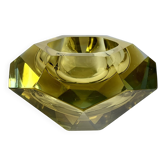
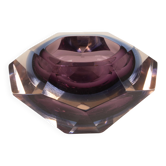
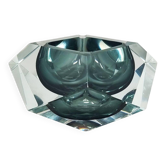
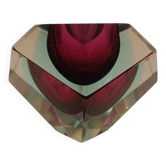
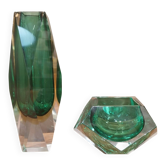
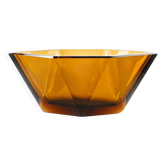
Art Deco vase, citrine crystal, designed by R. Hlousek, Moser, Czechoslovakia, 1930s

- Dimensions :
- H15 x W16 x D16
- Color :
- yellow
- Material :
- linen
- Style :
- art deco
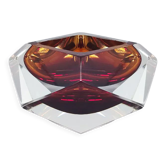
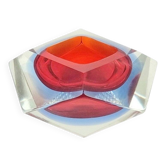
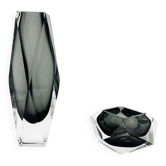
Art Deco vase from the 1930s, designed by Rudolf Hlousek for the Moser glassworks in Czechoslovakia, made of thick, transparent citrine-coloured crystal. The vessel's form oscillates between a polygonal profile and soft edge undulations, with faceted surfaces at sharp angles creating a rhythmic architecture typical of the era. The precise cut emphasises the play of light and shadow – each plane reflects and diffuses the glow, achieving a jewel-like clarity. The vase has no additional decorations or patterns – the purity of the material, far from excess, becomes the main carrier of visual strength. The glass colour is a bright, fresh yellow with warm tones, visible across the entire surface; the proportions of the vessel are monumental, and the whole is preserved in very good condition, without damage, chips or cracks. A delicate patina emphasises the authenticity of the object, whose surface retains a shiny, polished smoothness. This vase seems to be a voice of interwar Czechoslovakia – a time when modern architecture and design met with artisanal discipline. The geometric form, clear cut and transparent glass evoke the atmosphere of modernist interiors, where light – filtered through crystal – was an inseparable actor of everyday life. The citrine tone, softly diffused in the glass mass, emits a subtle glow, evoking images of a summer morning or an elegant hotel foyer from the interwar period – places where every detail mattered. In this form, the vase speaks of the harmony of austerity and luxury, convincing that light, rhythm and proportion are sufficient ornament. In arrangement, this vase can be used as a central accent on a walnut wood chest of drawers or among a modernist glass collection. It will look great both in a classic Art Deco-inspired living room and in minimalist, bright spaces, where its citrine colour will enliven a neutral palette. It can be paired with single flowers with dark stems or left empty, treated as an autonomous sculpture against a graphite wall or marble countertop. Surrounded by metal and glass, it will further emphasise its architectural character, becoming a reference point for other geometric forms.