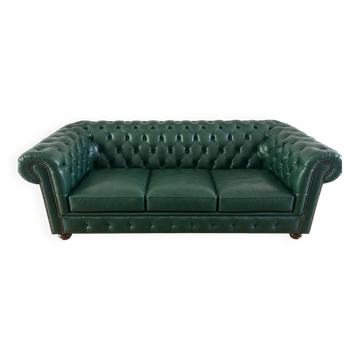
Three-Seater Sofa in Green Leather, Art Deco Revival, France, circa 1980

Stylistic revivals are rarely mere acts of nostalgia. When French furniture makers of the late 1970s and early 1980s returned to the vocabulary of Art Deco from 1925 — with its geometric forms, saturated leather upholstery, and preference for dark, rich tones — they were not reproducing the past but negotiating with it, questioning what that earlier moment understood about luxury, ornament, and the relationship between surface and structure, which the decades of brutalism and minimalism had too hastily dismissed. This dark green leather three-seater sofa is the product of that negotiation: it inherits the chromatic programme of Art Deco and its geometric discipline without reproducing any specific precedent from the 1920s. The choice of dark green leather is not arbitrary. In the original Art Deco of the 1925 Exhibition, leather appeared in saturated tones with an Eastern resonance — bottle green, deep jade, forest green — which asserted a chromatic break from the pale palettes of Louis XVI and Empire that had dominated French interiors during the previous century. These colours were associated with malachite, lacquer, and the Orientalist exoticism that Art Deco had absorbed and domesticated. The 1980 revival reproduced this chromatic argument intact: the dark green here is not a period colour but a structural element of the style, inseparable from its formal programme. At 161 cm wide, this three-seater sofa belongs to the French domestic scale — not the generous dimensions of American seating, but the more compact proportion suited to the Haussmannian salon or the composed luxury apartment. The depth of 83 cm and height of 72 cm confirm a classic geometry of seating: it invites an upright and sociable posture rather than horizontal relaxation. It is a sofa for conversation, for the carefully composed salon, for the interested.
Three-seater sofas: other similar vintage pieces
Discover more similar items- -28%
- -12%
- -10%
- -46%
- -25%
- -7%