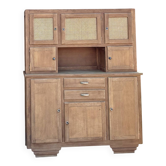
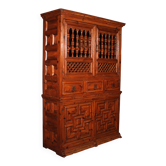
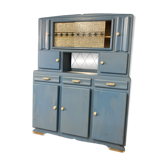
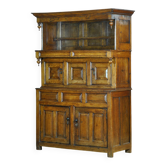
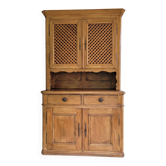
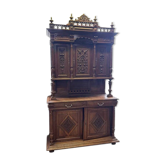
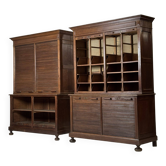
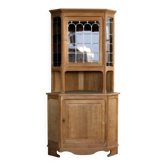
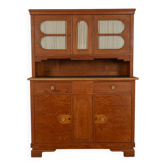
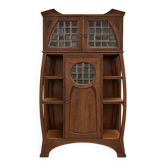
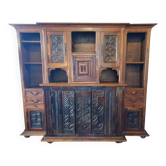
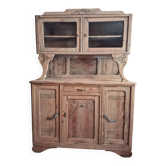
Mizuya dance ancient Japanese wooden keyaki – Japan, around 1930

- Dimensions :
- H151 x W70 x D42
- Color :
- brown
- Material :
- wood
- Style :
- vintage
This mizuya dansu, an ancient Japanese wooden piece made of keyaki, is a two-body kitchen cabinet with sliding doors and frosted glass. It originates from Japan, from the early Shōwa era, when traditional tansu cabinetry incorporated industrial glass. The mizuya dansu was the staple of Japanese kitchens: it stored dishes, utensils, and dry goods. It was constructed in two stackable bodies for ease of movement and transport through narrow corridors. The upper body features four sliding doors, two with frosted glass and curved muntins forming a cloud design, and two solid panel doors. A work surface extends between the two bodies. The lower body combines two central sliding doors with a radial pattern, a tall drawer with a brass handle, a hinged door, and two lower drawers. The keyaki of the central doors displays an open flame radial pattern, highly valued in Japanese cabinetry. The structure and drawers are made of sugi. The sliding doors glide in grooves carved directly into the wood, without hardware, and the recessed handles are made of brass. The original dark hue remains consistent and has gained depth, with a soft sheen on the most handled edges. The frosted glass is intact on all four panels. The back, made of vertical boards, shows wear typical of a continuously used piece. With a height of 151 cm and a width of only 70 cm, it is suitable for a kitchen, dining room, or hallway. It naturally fits into japandi and wabi-sabi interiors, serving as both a display cabinet for dishes and a closed storage unit. Details. Dimensions: Length 70 cm – Depth 42 cm – Height 151 cm. Style: Japanese Tansu. Materials and techniques: Keyaki and sugi; brass hardware; frosted glass; traditional Japanese joinery and sliding doors on carved grooves. Place of origin: Japan. Period: Shōwa era. Date of manufacture: Circa 1930. Condition / Observations: Good.
5 ()