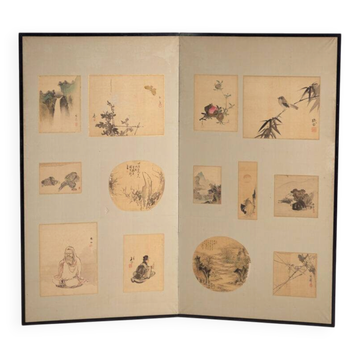
Ancient Japanese folding screen with two panels featuring painted collages – Japan, circa 1900

- Dimensions :
- H139 x W176 x D2
- Color :
- multicolour
- Material :
- paper
- Style :
- world's craft
This ancient Japanese two-panel screen is a byōbu in harimaze style, with paintings and calligraphy affixed to the background. It originates from Japan, from the Meiji era, when works from different artists were combined on a single screen. The harimaze screen brought together paintings, calligraphy, and fans from various origins, mounted together on a common background. It was a way to preserve and display a collection of small works. The two panels are made of paper on a wooden frame, joined by paper hinges, with a dark frame. On a floral-patterned paper background, the various works have been affixed in rectangular, fan, and column formats. The composition features figurative scenes, painted fans, and columns of calligraphy, from multiple artists and formats. The whole reads like a mosaic of small works mounted on a single surface. With its two-panel format, it serves as a decorative background or wall piece of collectible value. It fits into wabi-sabi, japandi, and eclectic interiors, where it adds texture and narrative. Details. Dimensions: Length 176 cm – Depth 2 cm – Height 139 cm. Style: Traditional Japanese. Materials and techniques: Paper and glued paintings (harimaze) on a wooden frame; paper hinges; wooden frame. Place of origin: Japan. Period: Meiji era. Date of manufacture: Circa 1900. Condition / Observations: Good. Harimaze mounting with water stains and missing pieces due to age. Folded dimensions: Length 88 cm – Depth 4 cm – Height 139 cm. Wear consistent with age and use.
5 ()
Screens & claustras: other similar vintage pieces
Discover more similar items- -20%
- -20%
- -16%
- -20%
- Sold out
- -10%
- Sold out
- -31%