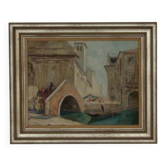
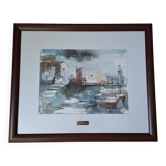
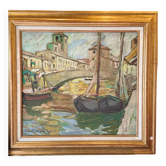
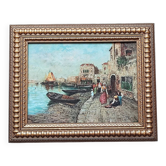
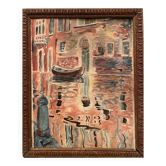
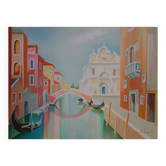
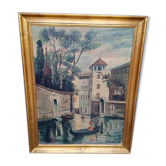
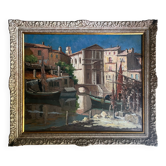
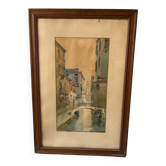
Alberto Prosdocimi (1852-1925) - Watercolor on paper - View of Venice
This item has found its owner, but other one-of-a-kind items await you. 👇
Discover similar items- Dimensions :
- H24 x W31 x D5
- Color :
- multicolour
- Material :
- paper
- Style :
- classic
Alberto Prosdocimi (1852-1925) Watercolor on paper. "View of Venice: Squero di San Trovaso, Dorsoduro" Signed lower right. Giltwood frame under glass. Dimensions with frame: 24 X 31 cm. Dimensions without frame: 17 X 24.5 cm. Very good condition, some foxing to the mat. *Alberto Prosdocimi (September 9, 1852 – 1925) was an Italian painter and manuscript illuminator. He often painted vedute of Venice in pale and luminous watercolors, many of which were sold abroad. He studied painting at the Venice Academy but also trained in his father's workshop. He often painted in watercolor, but like his father, he was a respected manuscript illuminator. [1] He copied the Grimani Breviary, preserved in the Library of St. Mark in Venice. He completed the diplomas of honor awarded by Florence to the Peruzzi workshop, its mayor. Queen Margherita commissioned him to create an illuminated portrait of the Prince of Naples. He also produced a richly illuminated album presented to the Queen by the aristocracy of Padua and Verona. He was employed as a painting teacher for Princess Hohenzollern-Sigmaringen and the Hereditary Grand Duchess of Holdenburg. The latter commissioned watercolors from him. He was one of the contributors to the seminal work "La basilica di S. Marco illustrata nella storia e nell'arte" (1878-1893), published by Ferdinando Ongania. Prosdocimi created the drawings of the basilica that were used in Ongania's chromolithographs. Gubernatis wrote of Prosdocimi's vedute of the Baptistery: "Through the regularity of its lines and perspectives, through the clarity of its light effects, it possesses the mathematical precision of well-known paintings, but it distinguishes itself by revealing with great intensity the poetry of the atmosphere, which Prosdocimi deeply felt without truncating the original sentiment; whereas among Venetians, it has an individuality, calculated and derived from conceptual studies.".