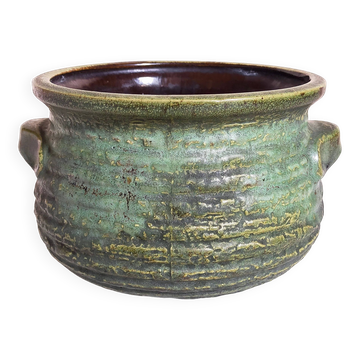
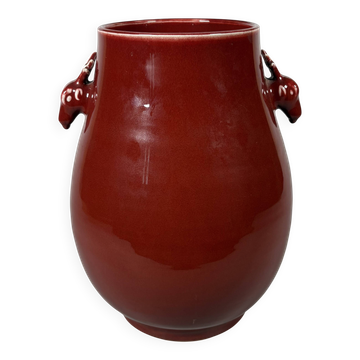
Pol Chambost (1906-1983) - Cache pot in cracked blue glazed earthenware

- Dimensions :
- H12 x W15 x D19
- Color :
- blue
- Material :
- ceramics, porcelain and earthenware
- Style :
- design
Pol Chambost (1906-1983) Cracked blue glazed earthenware cache pot, black interior. Animal-decorated handles. Signed underneath. Circa 1950. Height: 12.5 cm. Diameter (at the neck): 15 cm. Diameter (at the widest): 19 cm. Very good condition. Pol Chambost (1906-1983) was a French sculptor and ceramist, considered one of the greatest creators of forms and an icon of the 1950s style. Here are the key points of his career: From sculpture to clay: Born in Saint-Étienne, he first studied stone sculpture at the Applied Arts and Decorative Arts in Paris. He then joined his father's funeral marble business in Ivry-sur-Seine before definitively turning to ceramics in 1932. The pioneer of modernity: Visionary and prolific, he was one of the first in France to equip his workshop with a large-capacity electric kiln. This allowed him to produce small series that perfectly combined artisanal quality with technical efficiency. The peak of the 50s: After the war, he radically broke with the rigid style of Art Deco. He invented a unique repertoire made of curvilinear lines, sensual roundness, and biomorphic shapes (often inspired by nature or plants, like his famous Corolle vase). He enhanced his pieces with contrasts of vibrant colors (yellow, red, turquoise blue) often paired with matte black or satin white interiors or exteriors. The conquest of decorative arts: His pieces, both decorative and utilitarian (tableware, pitchers, lamps), enjoyed immense commercial success. He collaborated with major Parisian department stores (Le Bon Marché, Les Galeries Lafayette, Le Printemps) and renowned decorators like Jean Royère. In 1958, his objects even appeared on screen in the famous film Mon Oncle by Jacques Tati. Creative retirement in Dordogne: Co-founder of the union of art ceramists, he settled in Dordogne in 1965.
Planters: other similar vintage pieces
Discover more similar items- -43%
- -14%
- -19%
- -20%
- -43%
- -16%
- Sold out
- -20%
- -25%