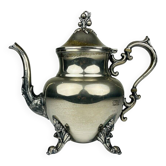
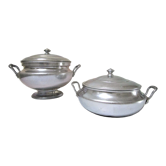
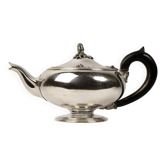
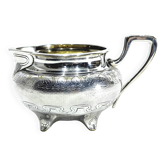
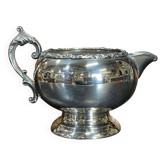
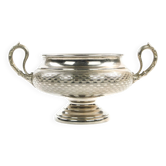
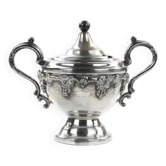
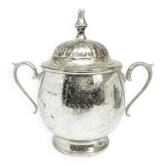
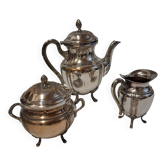
Art Nouveau sugar bowl, silver-plated brass, Norblin, Poland, 1920s

- Dimensions :
- H9 x W10 x D15
- Color :
- silver (Color)
- Material :
- brass
- Style :
- art nouveau
Art Nouveau sugar bowl from the early 20th century, made in Poland by Norblin, is an example of the artistic craftsmanship of the Art Nouveau era. The construction is based on brass covered with a layer of silver, giving it a cool, silvery tone with a slightly matte finish. The organic, bulbous shape of the body harmonises with smoothly curved, wavy handles, which fit harmoniously into the Art Nouveau aesthetic. The lid, shaped into a gentle dome and topped with a slender, conical handle, reflects the undulating line motif characteristic of this style. The whole is devoid of ornaments and engravings – the design focuses on the purity of form and subtly marked detail. The handle and lid are solidly set, and the proportions are balanced, as highlighted in the product photos. Condition: visible signs of use, patina and minor scratches, typical for an authentic antique from this era, without serious damage. The form of this sugar bowl evokes the spirit of the 1920s, when Art Nouveau still influenced everyday objects, making them carriers of art. Soft lines and an organic shape seem to flow like a plant motif, enclosed in metal. Subtle patina and traces of time tell of past afternoons over tea, of social gatherings in bourgeois salons, where art and utility went hand in hand. In this sugar bowl, echoes of an era that valued the harmony of nature and craftsmanship can be heard, turning even the daily ritual of sweetening into a gesture of artistic dimension. This sugar bowl can find its place on both a classic and eclectic table. It will work well with porcelain tableware with geometric or floral motifs or as a counterpoint to modern, minimalist forms. It is worth combining it with dishes in delicate, pastel colours or glass with simple lines – this will emphasise its Art Nouveau character without dominating the arrangement. It can also be displayed on a sideboard or shelf among other old collector's items, creating a sophisticated dialogue of eras.