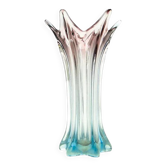
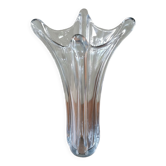
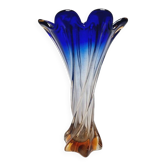
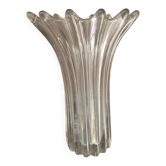
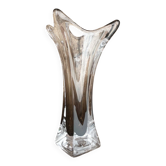
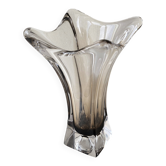
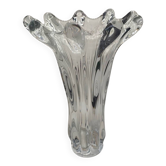
Murano vase, mid-century modern, glass, Italy, 1950s

- Dimensions :
- H24 x W16 x D16
- Color :
- brown
- Material :
- oak
- Style :
- mid-century
A Murano glass vase, crafted in the tradition of the Mandruzzato workshop, made in Italy in the 1950s, is an example of the mastery of the sommerso technique typical of the mid-century modern era. The piece impresses with its massive, balanced base and dynamic, irregular form with widely spread, star-shaped edges. The deep olive-brown colour, transitioning to lighter, almost transparent tones at the rim and base, highlights the layered structure of the glass. The surface is polished to a high gloss, enhancing the clarity and play of light in the form. The vase has no additional decorations or ornaments – its strength lies in its organic shape and refined simplicity. The piece is in very good vintage condition – no chips, losses, or signs of damage – and is an authentic example of Italian craftsmanship. This vase seems to tell the story of the golden age of Italian modernism – a time when glass became not only a utilitarian object but also a medium for artistic expression. The textured form and colour transitions evoke the image of evening light reflecting in the calm lagoons of Murano. Every angle and break in the form recalls the sculptural experimentation of Italian masters; the organic contour tells a story of freedom of form, balance, and harmony with which they created objects of everyday luxury. The vase can play a central role on a console or sideboard in the living room – displayed solo, it will showcase the subtlety of colour transitions and the nobility of the material. It pairs well with walnut or natural oak furniture, as well as with simple ceramics or small mid-century modern sculptures. In larger spaces, it can be combined with dark green or burgundy upholstery to emphasise the depth of the glass colour; in collector arrangements – paired with other examples of Murano art or geometric metals such as brass. It fits well in both classic and eclectic interiors, where the dialogue of forms and materials is important.