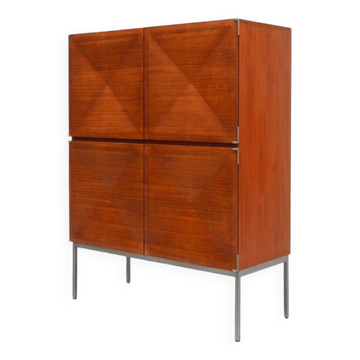
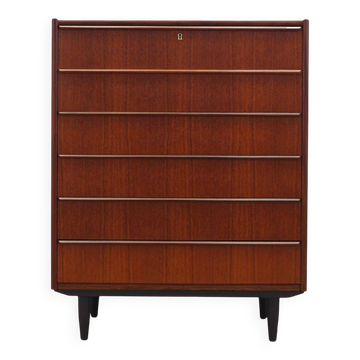
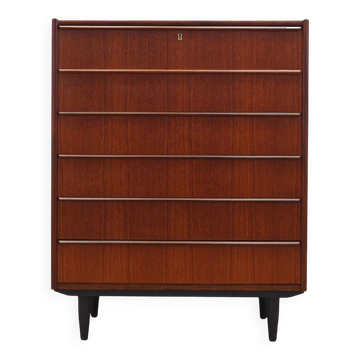
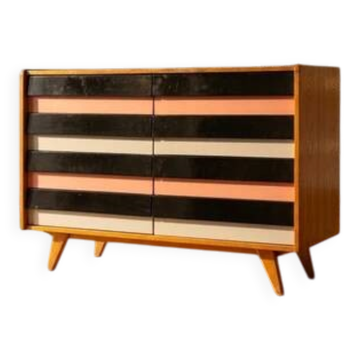
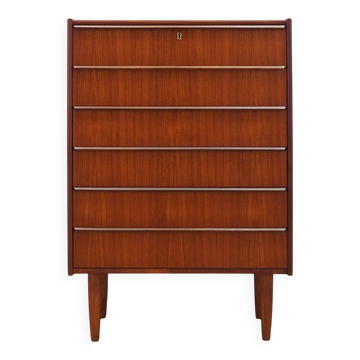
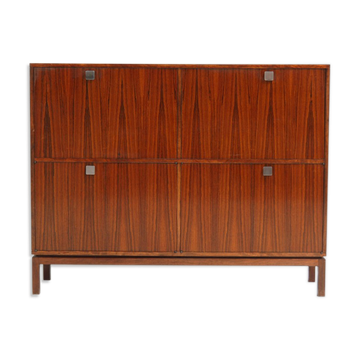
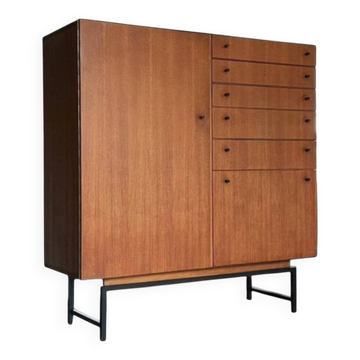
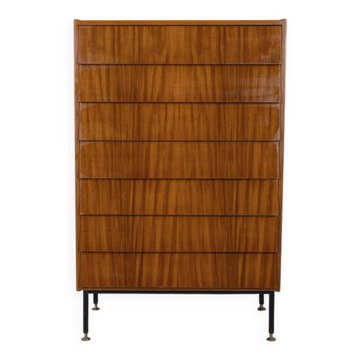
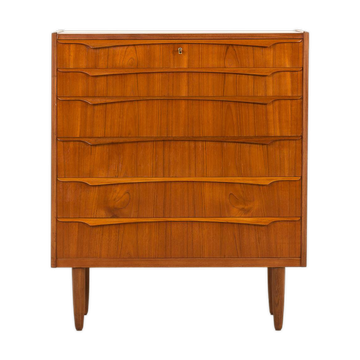
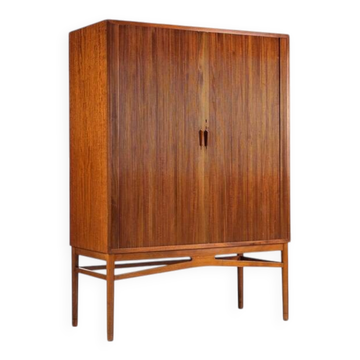
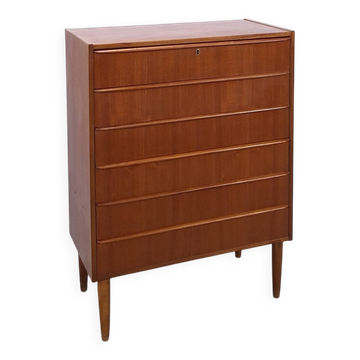
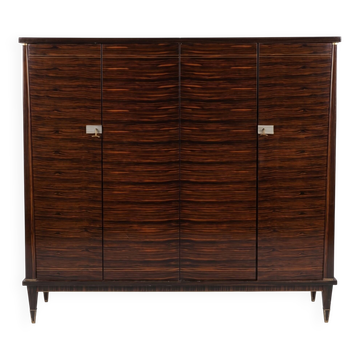
Wardrobe Carl-Axel Acking produced by Nordiska Kompaniet, Sweden, 1950s.

- Dimensions :
- H159 x W110 x D45
- Color :
- wooden
- Material :
- wood
- Style :
- scandinavian
Wardrobe Carl-Axel Acking produced by Nordiska Kompaniet, Sweden, 1950s. Rare mid-century Scandinavian wardrobe with a façade of graphic panels, probably produced in the 1950s–60s. What stands out immediately is the façade: a tight grid of vertical and horizontal lines, almost architectural. It gives the piece a marked rhythm and depth without becoming decorative. Subtle, yet very effective. The small brass details and the original key provide just the right amount of contrast with the warm tone of the wood. The wardrobe is elevated on slender legs with a slightly curved low crossbar, giving it a lighter, almost floating appearance despite its compact proportions. The construction appears solid and well thought out, typical of high-end Scandinavian designs from this period. Inside, there is a beautiful contrast. The darker exterior opens to a lighter interior with finely crafted shelves and a stack of drawers. The drawers have a soft, sculptural front edge and slide well. This mix of dark exterior and light interior always works visually and gives the piece a bit more depth in use. The wood has a rich, warm tone with a beautiful even patina. Light signs of use consistent with age, nothing bothersome. Overall in very good condition. A strong piece that works well in both minimalist and more composed interiors. Not too large, but with a real presence thanks to the graphic façade. We can handle shipping ourselves and are often much faster than others, with delivery to the United States and Asia sometimes in less than two weeks. Carl-Axel Acking (1910–2001) was a Swedish modernist designer trained at the Royal Institute of Technology in Stockholm, closely linked to the functionalist movement through his work with Sven Markelius. He is best known for his collaboration with Nordiska Kompaniet (NK), where he developed interiors and furniture with great architectural clarity and refined details. Although less widely marketed than some of his contemporaries, Acking is regularly cited in literature on Scandinavian design, including publications by Charlotte and Peter Fiell, and featured in exhibitions such as the Milan Triennale. His work is generally appreciated for its restraint, proportions, and subtle articulation of surfaces rather than for ostentatious decoration. Dimensions. Width: 110 cm. Height: 159 cm.