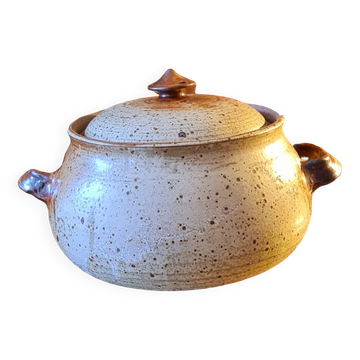
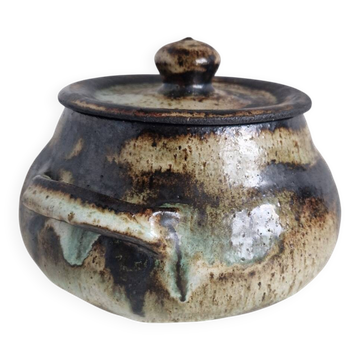
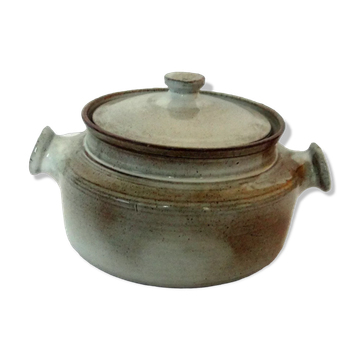
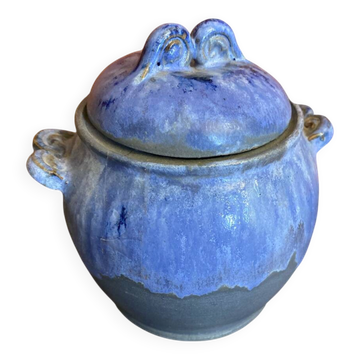
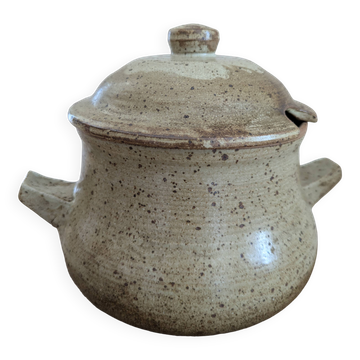
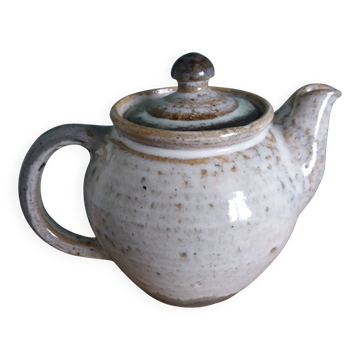
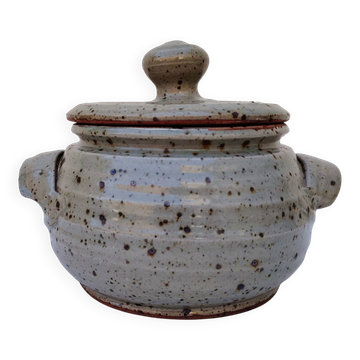
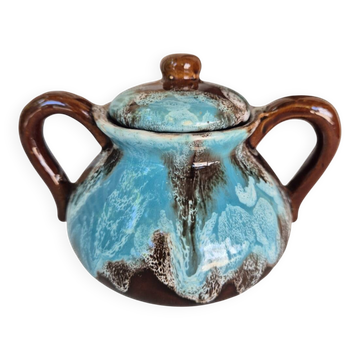
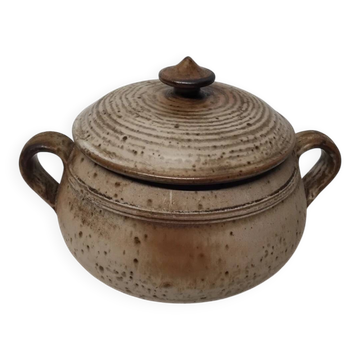
Alexandre Bigot (1862-1927) - Covered sugar bowl in glazed stoneware - Signed 1911

- Dimensions :
- H8 x W13 x D13
- Color :
- beige
- Material :
- ceramics, porcelain and earthenware
- Style :
- art nouveau
Alexandre Bigot (1862-1927) Covered sugar bowl in glazed stoneware. Signed and dated 1911 underneath. Height: 8.5 cm. Diameter: 13 cm. Good condition, chips underneath. Alexandre Bigot (1862-1927) was a French chemist and ceramist, a major figure of Art Nouveau, famous for revolutionizing the use of flame-fired stoneware in architecture. Nothing predestined this chemistry doctor for an artistic career. Initially a teacher, he experienced a true aesthetic shock at the 1889 World's Fair in Paris upon discovering Japanese and Chinese ceramics. Fascinated by the material, he decided to apply his scientific skills to mastering glazes and high-temperature firings. He set up his first kilns in Mer, in Loir-et-Cher, in 1889, and founded the company A. Bigot et Cie in 1897. Thanks to his perfect mastery of chemistry, Bigot created stoneware coatings with unique shades (iridescent effects, veined drips, matte or glossy textures) that were exceptionally resistant to the elements. He became an indispensable partner to the greatest architects of the Belle Époque, such as Jules Lavirotte, Hector Guimard, and Henri Sauvage. He was the first to integrate decorative ceramics on a large scale into modern reinforced concrete structures, adorning the facades of famous Parisian buildings (like the Lavirotte building at 29 avenue Rapp) with masks, friezes, and exuberant organic motifs. Alongside his architectural work, his workshops produced numerous domestic art objects (vases, ashtrays, statuettes) in collaboration with renowned sculptors like Auguste Rodin and Antoine Bourdelle. After World War I, faced with the decline of Art Nouveau and changing tastes, he redirected his activities towards industrial consulting before passing away in 1927. His works are now preserved in major museums, notably the Musée d'Orsay.
Sweet boxes & sugar bowls: other similar vintage pieces
Discover more similar items- -64%
- -20%
- -17%
- -21%
- -18%
- -19%
- -33%
- -19%
- -9%
- -18%