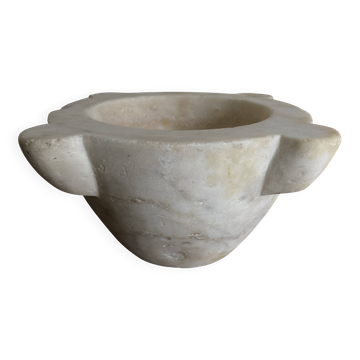
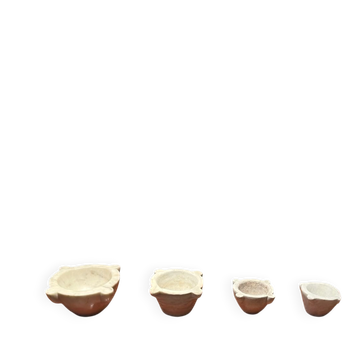
White Marble Mortar with Fluting, 18th Century

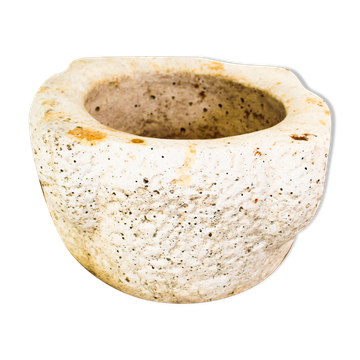
This large white marble mortar illustrates the excellence of mechanical arts in 18th century France. Its inverted truncated cone shape, elegantly flared at the top and narrowed towards a rounded base, demonstrates a perfect mastery of stone turning: the horizontal ribs that adorn the body have been executed on the lathe with a regularity and finesse that are more akin to the work of a lapidary than to simple utilitarian production. The slightly veiled whiteness of the marble, animated by fine crystallisation, gives the whole a discreet light and timeless elegance. The upper rim is punctuated by four protruding lobes, arranged in a cross, whose rounded contour and lightness of execution evoke more of a decorative ornament than mere functional appendages. These small ears allowed for easy handling and presentation of the mortar, whether it was on the work table of an apothecary, in a surgeon's office, or in the kitchens of a grand residence. The generous size of this piece — 25.5 cm in diameter and 13.5 cm in height — made it a top-quality tool for operations requiring strength and capacity: grinding spices, preparing pigments, or triturating plant drugs in pharmacy offices. The quality of the chosen marble and the care taken in the turned ornamentation suggest a commissioned piece, likely intended for an affluent bourgeois residence or a professional concerned with appearance. Presented without a pestle, this mortar bears the discreet marks of its past use — a few traces of oxide and a slight interior patina that attest to its authentic age without diminishing its beauty. An object at the crossroads of art and functionality, it will naturally find its place in a cultured interior, both as a collector's item and as a tangible reminder of the French artisanal heritage of the Enlightenment.
Planters: other similar vintage pieces
Discover more similar items- -20%
- -30%
- -21%
- -60%
- -20%
- -20%
- -20%