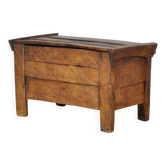
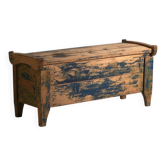
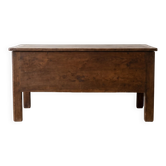
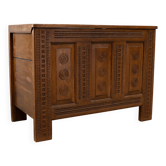
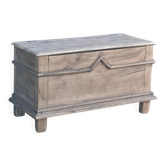
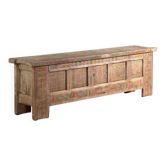
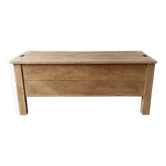
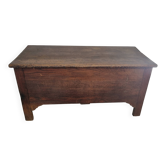
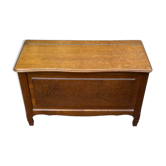
Antique carved pine chest – Central Europe, circa 1850

- Dimensions :
- H54 x W91 x D45
- Color :
- brown
- Material :
- wood
- Style :
- art nouveau
This ancient carved pine chest is a peasant chest from Central Europe, featuring incised carvings and remnants of red polychromy. It originates from Central Europe, dating to the mid-19th century, where the solid wood was decorated with a knife and compass. The incised carving — chip-carving from the Alpine and Carpathian tradition — was the decoration for those who had no access to pigments or cabinetmakers. It was traced with a compass and hollowed out with a knife, and its repertoire of rosettes and diamonds has been repeated almost unchanged for centuries in trousseau furniture. The chest is made of solid pine, with extended uprights as feet and a single-piece lid with sculpted projections at the ends. The front boards are joined with half-lap joints, and the bottom is reinforced with cross braces. The front features three registers of diamond-shaped rosettes and lanceolate leaves traced with a compass; the uprights are decorated with chevron bands. The lid repeats the motif on a smaller scale. An earthy red was applied to the carving, of which a glaze remains, and the sides retain a painted leaf in the same red, more legible than the rest. The surface has taken on a warm tone between honey and garnet, with old woodworm damage stabilised and some losses on the edges. The carving has softened to become almost tactile. No restoration, no filler. Details. Dimensions: Length 91 cm – Depth 45 cm – Height 54 cm. Style: Folk art from Central Europe. Materials and techniques: Pine wood; half-lap joints; incised carving with knife and compass; remnants of red polychromy. Place of origin: Central Europe – Carpathians. Period: 19th-century folk art. Date of manufacture: Circa 1850. Condition / Observations: Good. Carving softened by use, old woodworm damage stabilised and losses on the edges. Wear consistent with age and use.
5 ()