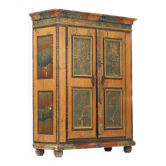
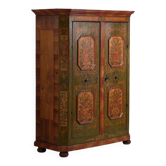
Antique baroque wardrobe painted in pine – Austro-Hungarian Empire, Year 1794

This antique baroque wardrobe painted in pine is a Central European two-door cabinet with a scalloped pediment, faux marble, and the date 1794 painted on the crown. It originates from Central Europe during the Austro-Hungarian Empire period, at the end of the 18th century, when peasant furniture assimilated the vocabulary of late baroque. The two-door wardrobe was the major piece of furniture in the home and was commissioned on the occasion of a marriage or inheritance. The date painted on the crown does not date the wood but this event, serving as a public signature of the trousseau. The case is made of solid pine, with a back of vertical boards, and rests on turned ball feet. Two framed doors close over an unpainted interior, with shelves and a rail. Below runs a drawer with a moulded front and turned knob. The background is an olive grey. The mouldings are gilded with ochre and highlighted in red; the uprights, strips, and the crown feature a faux blue veined marble, executed with a sponge and brush. Each panel encloses a bouquet of roses, carnations, and blue-green leaves. On the scalloped pediment, finished with volutes and fluted capitals, the date 1794 is painted in red with rocaille motifs. The fittings are made of cast bronze in a rococo style: keyholes in a palmette design with a hasp and floral rosette handles, all original. Details. Dimensions: Length 160 cm – Depth 54 cm – Height 187 cm. Style: Popular Baroque of Central Europe. Materials and techniques: Pine wood; keyholes and handles in cast bronze; mortise and tenon joinery; oil painting, ochre gilding, and faux marble. Place of origin: Central Europe – Austro-Hungarian Empire. Period: Popular Baroque of the 18th century. Date of manufacture: Year 1794. Condition / Observations: Good. Original polychromy dated 1794, worn gilding on the edges and occasional losses in the mouldings. Wear consistent with age and use.
5 ()
Wardrobes: other similar vintage pieces
Discover more similar items- Sold out
- -17%
- -17%
- -17%
- -11%
- Sold out
- -18%
- -24%