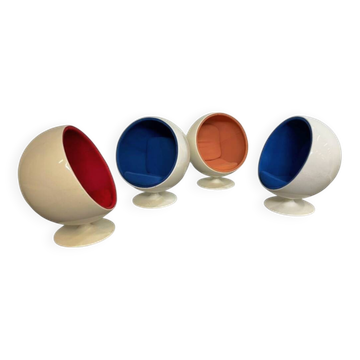
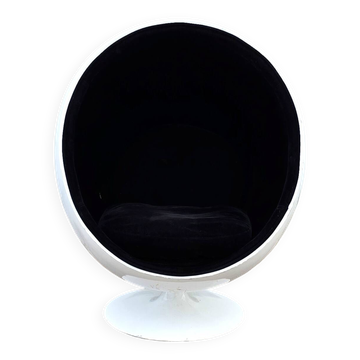
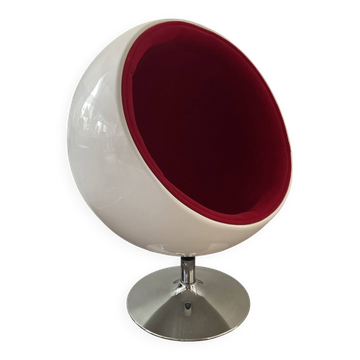
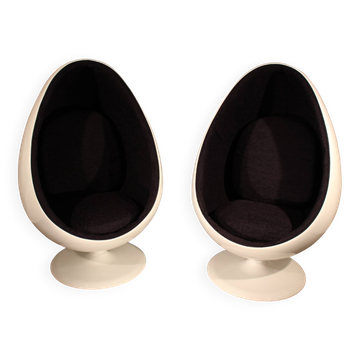
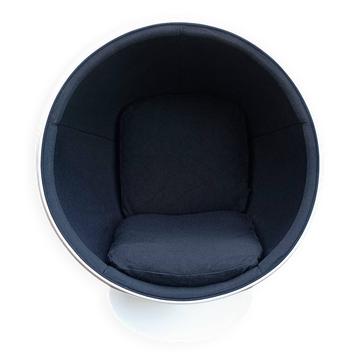
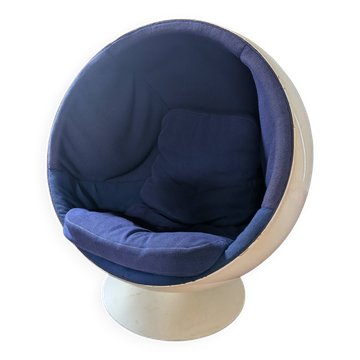
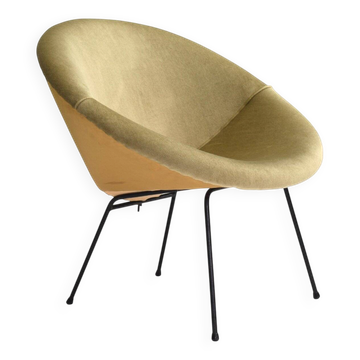
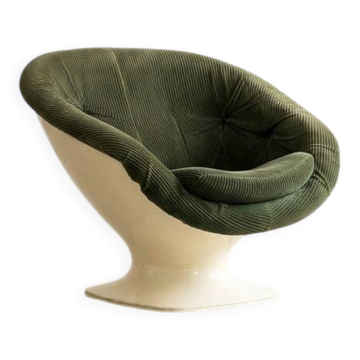
Ball Chair by Eero Aarnio from the 1980s.

DIAGNOSTIC ANALYSIS OF AUTHENTICITY A combined visual inspection of the internal section of the fabric and the lower base certifies the absolute authenticity of the piece compared to commercial replicas on the market. A. Composition and treatment in fibreglass. Evidence: The underside of the sphere has a raw, unpainted finish, clearly showing the manual layering of fibreglass bonded with polyester resin. Chronological indicator: The amber/honey yellow colour is the result of natural ageing and the photo-oxidation process of vintage polymers over more than 50 years. B. Mechanical components for rotation. • Evidence: At the exact geometric centre of the lower shell, there is an integrated cylindrical metal sleeve, embedded directly into the fibreglass during the factory moulding process. • Structural consistency: This female joint is designed to fit perfectly in a "bayonet" manner with the spindle of the cast aluminium base, ensuring smooth 360-degree rotation. There are no square metal adapter plates or exposed bolts under the sphere, which are common features of counterfeit editions. C. Analysis of the textile compartment. • Textile factory: The thickness, elastic recovery on the concave walls, and bright red colour are characteristic of the Tonus fabric produced by the Danish textile company Kvadrat. This yarn has historically been chosen by Asko to ensure a wrinkle-free and seamless covering on spherical surfaces while providing acoustic insulation. D. ATTRIBUTION AND HISTORY Based on the handmade composite materials on the underside and the specific mechanical configuration, this piece is attributed to the production of Asko Oy (Lahti, Finland). The most plausible production period is between 1966 (the year of the international launch of the model at the Cologne Furniture Fair) and the first half of the 1970s, a time before the base moulding processes were standardised or concealed by the use of plastic finishing caps.
Lounge & easy chairs: other similar vintage pieces
Discover more similar items- -13%
- -10%
- -17%
- -25%
- -25%
- -33%