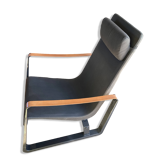
Cité lounge chair by Jean Prouvé for Vitra, 1930

- Dimensions :
- H84 x W68 x D97
- Color :
- black
- Material :
- leather
- Style :
- modernist / bauhaus
The Cité lounge chair by Jean Prouvé is one of the significant early designs by the French engineer and designer. It is characterized by its exceptionally light, almost graphic silhouette, its sweeping runners, and the broad leather straps of the armrests. In this example, the black leather upholstery is paired with a black metal frame and cognac-colored leather – a particularly elegant combination that impressively highlights the chair’s structural character. The Cité offered here is in excellent condition. The black leather is well-maintained and supple, and the frame and cognac-colored leather armrests show only minimal signs of wear. The height-adjustable headrest is also in excellent condition. According to the Vitra brand label present, the chair was manufactured in 2021. It is therefore an authentic Vitra edition of the historic design by Jean Prouvé. Jean Prouvé designed the Cité in 1930 for the furnishings of the Cité Universitaire in Nancy. The chair is thus among his earliest furniture designs. Vitra itself describes it as one of Prouvé's early masterpieces. Notably, Prouvé apparently held this design in high regard: a Cité chair was also kept in the living room of his own home. The construction expresses Prouvé’s design philosophy with particular clarity. Rather than using form merely as decoration, he made the structural elements themselves the design focus. The side metal frame visibly traces the forces at work, while the long leather straps serve as both armrests and a striking design feature. This combination of engineering logic, function, and a reduced design language places the Cité in proximity to the ideas of the Bauhaus and classical modernism, even though Prouvé himself was not a Bauhaus designer. Jean Prouvé (1901–1984) was an engineer, architect, designer, and trained metalworker. Rather than viewing furniture primarily as sculptural objects, he developed them from material, manufacturing processes, and static requirements.
Lounge & easy chairs: other similar vintage pieces
Discover more similar items- -12%
- Sold out
- -29%